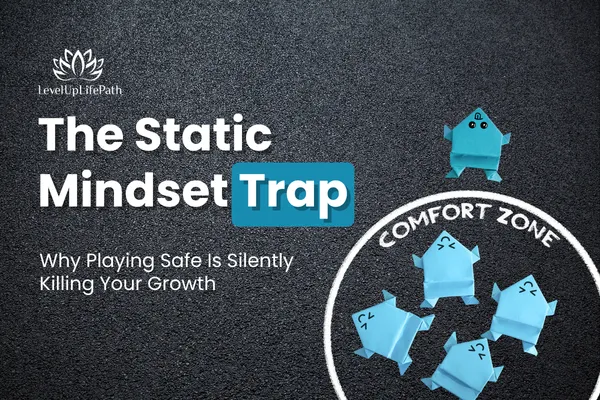
The Static Mindset Trap: Why Playing Safe Is Silently Killing Your Growth
The Static Mindset Trap: Why Playing Safe Is Silently Killing Your Growth
Most people don’t stop growing because they fail; instead, they continue to learn and improve. They stop because they stop trying. Comfort feels safe and predictable, but it slowly traps you. You might not notice you’re stuck until everything feels the same: the same routine, the same excuses, and the same dreams you never pursue.
This is the static mindset trap: believing that staying safe means staying secure. But safety without progress leads to stagnation. Stagnation can feel like peace, but it’s really just decay in disguise.
The Fixed Mindset and Its Hidden Cost
A fixed mindset tells you that you’re either talented or not, ready or not, good enough or never will be. It may sound reasonable, but it’s really fear pretending to be logic.

If you think your abilities can’t change, you avoid challenges. You stick with what you know, stop trying new things, and start reacting to life instead of creating your own path.
The result? You lose your curiosity and your drive. You start shrinking to fit what’s easy and call it comfort.
But the hidden cost runs deeper. The fixed mindset convinces you to protect your ego instead of your potential. You’d rather look capable than learn something new. You play small so you don’t risk failure, and in doing so, you fail quietly, without ever testing your limits.
Over time, this mindset builds invisible walls. It traps you in routines that feel safe but keep you stagnant. The fear of looking foolish replaces the joy of discovery.
Growth doesn’t happen in control; it happens in challenge. Every skill you admire in others was once unfamiliar to them, too. The moment you trade “I can’t” for “I can learn,” the world opens up again. That’s when real progress begins.
The Comfort Zone Trap
The comfort zone trap doesn’t look like failure. It looks like success without real satisfaction. You might say you’re “fine,” “stable,” or “doing okay,” but deep down, you feel a quiet ache that tells you there’s more for you.
Growth feels risky because it requires discomfort. You have to let go of old habits and question beliefs that once kept you safe. Each time you choose comfort over challenge, you teach yourself to settle and become better at avoiding action than taking it.

Breaking free starts with being honest with yourself. Ask yourself:
What part of my life feels predictable but unfulfilling?
What am I avoiding because I’m afraid to be seen trying?
What am I calling “peace” that’s really fear of change?
Your answers will show you where you’ve stopped growing.
The Fear of Change and Its Many Masks
Fear of change doesn’t usually announce itself. It hides behind logic, responsibility, and “timing.” You might tell yourself:
“Now isn’t the right time.”
“I’ll try when things calm down.”
“I just need to prepare a bit more.”
But life is never stable for long. If you wait for perfect conditions, you’ll be waiting forever.
Change doesn’t break you; resisting it does. The longer you avoid the unknown, the more anxious and restless you feel. But once you take action, even if it’s not perfect, your fear starts to fade.
Change requires courage, not certainty.
Creative Freedom Comes From Risk
True creative freedom doesn’t come from control. It comes from giving yourself permission to fail, explore, look foolish, and start over.
When you stop aiming for perfection, you find joy in trying new things. You stop chasing perfect results and start seeking new experiences. Originality comes from play, not predictability.
If you feel creatively blocked, it’s not because you lack talent. It’s because you’re protecting yourself too much. You might be editing your ideas before they even form. Try this rule: nothing has to be perfect; it just has to be real.

Creativity thrives on risk because risk brings aliveness. The best ideas come when you stop worrying about judgment and start following curiosity. You experiment. You fail. You learn. That’s how creative breakthroughs happen through motion, not hesitation.
Taking creative risks doesn’t mean being reckless. It means daring to test what’s possible without demanding certainty first. Every new idea starts as an imperfect attempt. The courage to create comes before the skill to refine.
When you make peace with imperfection, you stop creating to impress and start creating to express. And that’s where freedom lives in the messy, unpredictable space where real art, innovation, and authenticity are born.
Personal Stagnation Feels Like Peace Until It Hurts
Stagnation is quiet. It doesn’t show up as failure; it slips in through routine. One day, you notice you’re on autopilot. You stop feeling excited, stop learning, and stop asking questions.
That’s the risk of comfort: it feels good just before it stops your progress.
You don’t need to start over completely to grow. Growth doesn’t always mean big changes. Sometimes, one decision can open new doors, such as signing up for a class, applying for a new job, or having a conversation you’ve avoided for years.
The pain of feeling stuck is there to remind you that you’re capable of more.
Stagnation pretends to be safety, but it slowly drains your energy. It keeps you predictable when what you need is a possibility. The longer you stay in the same mental space, the smaller your world becomes.
Growth starts the moment you choose discomfort over dullness. Take a small risk. Change your routine. Ask yourself what you’ve been postponing out of fear. Progress doesn’t always announce itself; sometimes it begins with quiet, consistent action.
When you outgrow stagnation, life doesn’t suddenly get easier; it gets real. And in that reality, even uncertainty feels more alive than the false peace of standing still.
How to Escape the Static Mindset
To escape a static mindset, learn to see discomfort as a sign of progress, not punishment. The more you resist change, the more trapped you feel. Growth begins the moment you stop avoiding what challenges you.

Try this:
Change how you see failure. Every mistake is information. Each setback teaches you how to adapt and build new skills. Failure isn’t proof of weakness; it’s evidence you’re trying.
Say yes to small risks. Send that email. Speak up. Test your idea. Momentum builds confidence. Small actions train your brain to see uncertainty as an opportunity.
Change one routine. Work from a new spot. Take a different route. Learn a new tool. A shift in environment breaks mental autopilot and sparks creativity.
Reward effort, not perfection. Real growth happens between attempts, not after success. Notice the work you put in, even if results aren’t visible yet.
Escaping the static mindset doesn’t mean forcing big leaps. It’s about moving forward one decision at a time. Each time you act despite hesitation, you rewire your brain for adaptability.
Growth isn’t glamorous; it’s gritty, slow, and uncomfortable. But it’s also freeing. The static mindset keeps you safe. The growth mindset keeps you alive.
If learning how to adapt, release control, and grow through discomfort resonates with you, these ideas are explored in more depth in Breaking Free from the Static Mindset , a practical guide to building resilience through intentional challenge.
The Real Meaning of Progress
Progress doesn’t always feel like success. Sometimes it feels messy, full of doubt, or like starting over. That’s what real growth feels like, messy but meaningful.
The key is to keep moving, even when it’s uncomfortable. Every time you leave your comfort zone, you expand your sense of who you are.
Progress isn’t a straight path; it’s more like a heartbeat. As long as it keeps going, you’re growing.
The Mindset Shift That Changes Everything
Stop asking yourself, “What if it doesn’t work?” and start asking, “What if I never try?”
Playing it safe might protect your ego, but it holds back your growth. The people who change the most aren’t always the smartest; they’re the ones most willing to begin again.
Security doesn’t last forever, but growth does. Choose what helps you grow, not what keeps you stuck.
A static mindset feels safe because it demands nothing from you. But it also gives you nothing in return.
If you want a life that feels exciting, you need to trade certainty for curiosity. Let go of the idea of perfect safety and trust yourself to adapt.
Playing it safe won’t keep you from failing. It will only keep you from becoming who you’re meant to be.
Take action, even if it’s small or messy. The moment you choose to move instead of staying afraid, the static mindset fades and your growth begins.
If you’d like to dive deeper into mindset, resilience, and self-development, you can explore our full collection of books and bundles on the Ebooks Overview page.